When I moved to Austin in 2005, I left behind the amusement park I had grown up with.
Paramount's Kings Dominion was more than a place I visited occasionally. I had watched it grow, followed each new attraction, and developed the kind of connection people have with a park that becomes part of their childhood.
My new home park was Six Flags Fiesta Texas in San Antonio.
That adjustment took time. Texas was hotter, the parks were farther apart, and the amusement park scene felt fairly stagnant compared with what I had left in Virginia.
Years later, I became a genuine fan of both Fiesta Texas and SeaWorld San Antonio. Their investments helped pull me back into the hobby, and I started paying closer attention to the people and decisions shaping amusement parks across Texas.
Then Circuit of the Americas announced COTALAND.
Austin had been waiting for a real amusement park
In November 2021, Circuit of the Americas revealed plans for a 21-acre amusement park beside its Formula 1 racetrack outside Austin.
The plans included family attractions and major thrill rides, with roller coasters connected to manufacturers such as Gerstlauer and Vekoma. A prototype flat ride from Skyline Attractions was also part of the early vision.
For Central Texas, this was a major announcement.
Austin had grown into one of the country's most recognizable metropolitan areas, but residents still had to drive to San Antonio or Arlington for a full amusement park experience.
COTALAND could change that.
It could give Austin-area families a home park while creating another reason for travelers to visit Circuit of the Americas outside Formula 1, NASCAR, concerts, and other major events.
The idea immediately caught my attention because this was not an established amusement park adding another roller coaster. COTALAND was trying to build the entire experience from the ground up.
Building a park is different from adding a ride
Companies such as Universal and Merlin Entertainments have established systems for creating new destinations.
They have experienced development teams, familiar vendors, and operating models refined across multiple parks. Even with those advantages, projects can take years to move from an announcement to opening day.
COTALAND faced a different challenge.
The team was assembling a new Austin amusement park inside an active motorsports and entertainment complex. Every ride needed a location. Every foundation, utility connection, pathway, building, and guest area had to work around the existing COTA property.
That made me curious about what the construction process actually looked like when there was no existing park infrastructure to build upon.
I reached out to COTALAND's Matt Hughey in 2022 and asked if I could follow the project more closely.
The ride pieces were already waiting
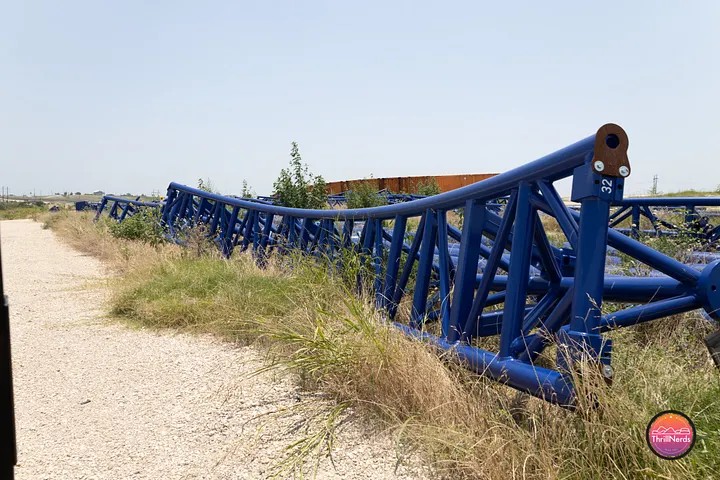
On a 102-degree day in Austin, I joined Hughey on a golf cart and toured the Circuit of the Americas property.
Rows of shipping containers held ride components waiting for their turn in the construction schedule. Pieces of Palindrome rested in the sun. Log flume sections and other attraction components were stored around the site.
The park existed in pieces, but most of those pieces could not be assembled yet.
It reminded me of having a large Lego set spread across the room while the only table available was still being used for meals, homework, and everything else happening in the house.
Circuit of the Americas was that table.
COTA remained an active venue with races, concerts, grandstand projects, and other events continuing throughout the year. Construction crews could not simply take over the entire property until COTALAND was finished.
The team had to build around everything else the venue was already doing.
Construction delays were easy to misunderstand
As the original COTALAND timeline slipped, skepticism began spreading through the amusement park community.
People could see ride pieces stored on the property, but they could not see much vertical construction. Updates became less frequent, and the lack of visible progress made the project feel uncertain from the outside.
The reality was much less dramatic.
Large construction projects depend on permits, specialized equipment, engineering, utility planning, environmental reviews, and access to the site. A delay in one area can prevent several other pieces from moving forward.
Central Texas was also experiencing enormous construction demand. Finding the right equipment and contractors was not always simple.
Hughey mentioned the difficulty of securing drilling equipment capable of working effectively on the property's hilly terrain. Local permitting also took longer than expected as the Austin area continued handling a large volume of development.
Those delays were frustrating, but they were part of building something complicated in one of the fastest-growing regions in the country.
Circuit of the Americas creates unusual limitations
COTALAND's location gives it several long-term advantages.
The park can benefit from visitors already traveling to Circuit of the Americas for Formula 1, NASCAR, MotoGP, concerts, and other events. COTA already has name recognition and a large property close to Austin.
The same setting makes construction more complicated.
Race weekends require large portions of the property for guests, operations, parking, temporary structures, and support equipment. Concerts and grandstand projects create additional scheduling conflicts.
Heavy construction equipment cannot always move freely through the site simply because COTALAND needs it.
Crews have to coordinate around a venue that never really stops operating.
This helps explain why ride components could be delivered long before crews were ready to install them. Owning the pieces and having access to the land were only part of the process.
The land itself can force plans to change
Once permits began moving forward, the property introduced additional challenges.
Tree preservation, floodplain requirements, underground utilities, soil conditions, and foundation engineering could all affect where an attraction was placed.
A ride may look perfect in an early rendering and still need to move after crews study the actual site.
Electrical lines may cross the proposed footprint. A foundation may require additional engineering. A protected tree may change the shape of a pathway or queue.
Those adjustments can affect nearby rides and buildings, creating another round of design work.
That is one reason early COTALAND plans could not be treated as a finished park map.
The vision remained ambitious, but building it required constant adaptation.
Quiet periods did not mean the project had stopped
The lack of frequent public updates made the delays harder for enthusiasts to understand.
COTALAND had announced a major attraction lineup, and people naturally wanted to see those rides rise from the ground. When that did not happen immediately, every quiet month created more questions.
Behind the scenes, the team was still dealing with engineering, permits, site preparation, and the logistics of constructing a park inside COTA.
Those are difficult things to communicate because they do not produce dramatic construction photos.
A completed permit or relocated utility line may be essential to the project, but it does not create the same excitement as seeing Palindrome track installed or watching Circuit Breaker's tilt mechanism rise above the property.
The visible park had not arrived yet. The work required to make it possible was continuing.
Matt Hughey was building the park he wanted to operate
The strongest impression I took away from my time with Hughey was how personally invested he was in COTALAND.
He was not approaching the project as someone trying to assemble a temporary collection of rides beside a racetrack.
He wanted to create a destination that Austin families would return to and a park where children could build the same kind of memories I had formed at Kings Dominion.
Hughey brought more than a decade of park operations experience from Six Flags Over Texas. He had also recruited former colleagues who understood what it takes to operate rides, manage crowds, and create an experience guests want to repeat.
That operational background matters during construction.
A ride can look impressive in a rendering and still create problems if its queue, capacity, maintenance access, shade, or surrounding pathways are poorly planned. People who have operated parks understand how those decisions affect a normal day after the opening celebration is over.
COTALAND was being designed as more than a collection of rides
The early attraction lineup was enough to get enthusiasts interested.
Palindrome promised a compact Gerstlauer shuttle coaster with forward and backward elements. Circuit Breaker introduced a Vekoma tilt coaster to the Austin market. The log flume, flat rides, and children's attractions gave COTALAND a broader family lineup.
The larger goal was creating a place people would want to stay.
That requires landscaping, comfortable pathways, food, shade, seating, entertainment, and an atmosphere that feels intentional.
Central Texas did not need a permanent carnival with rides placed around an open lot. It needed an amusement park that could become part of the community.
Hughey's vision was centered on that long-term experience.
My skepticism changed after seeing the property
I approached the COTALAND project cautiously.
The delays were real. The attraction list was ambitious, and very little of the future park was visible to guests at the time.
Touring the property gave me a better understanding of what was happening.
The ride components existed. The team understood the operating challenges ahead, and the setbacks had specific explanations rooted in permits, equipment, environmental requirements, and access to an active venue.
None of that guaranteed an easy path to opening.
It did show me that COTALAND was more than a rendering or an idea announced to generate attention.
The park was being built by people who wanted Austin to have a destination of its own.
Central Texas could finally have a home park
The part of COTALAND that interested me most was never one individual roller coaster.
It was the possibility of Central Texas families developing a relationship with a park close to home.
They could follow each new attraction, return for seasonal events, and watch the property change over time. Children growing up around Austin could have a park that felt like theirs instead of a destination requiring a day trip to another city.
That kind of connection does not appear on a construction schedule.
It develops slowly as a park opens, learns from its guests, and continues investing in the experience.
COTALAND still had a mountain of work ahead in June 2023. After meeting Hughey and seeing what was already waiting across the COTA property, I believed the team understood what it was trying to build.
The pieces were there.
The difficult part was finding the time, space, permits, and equipment to finally put them together.