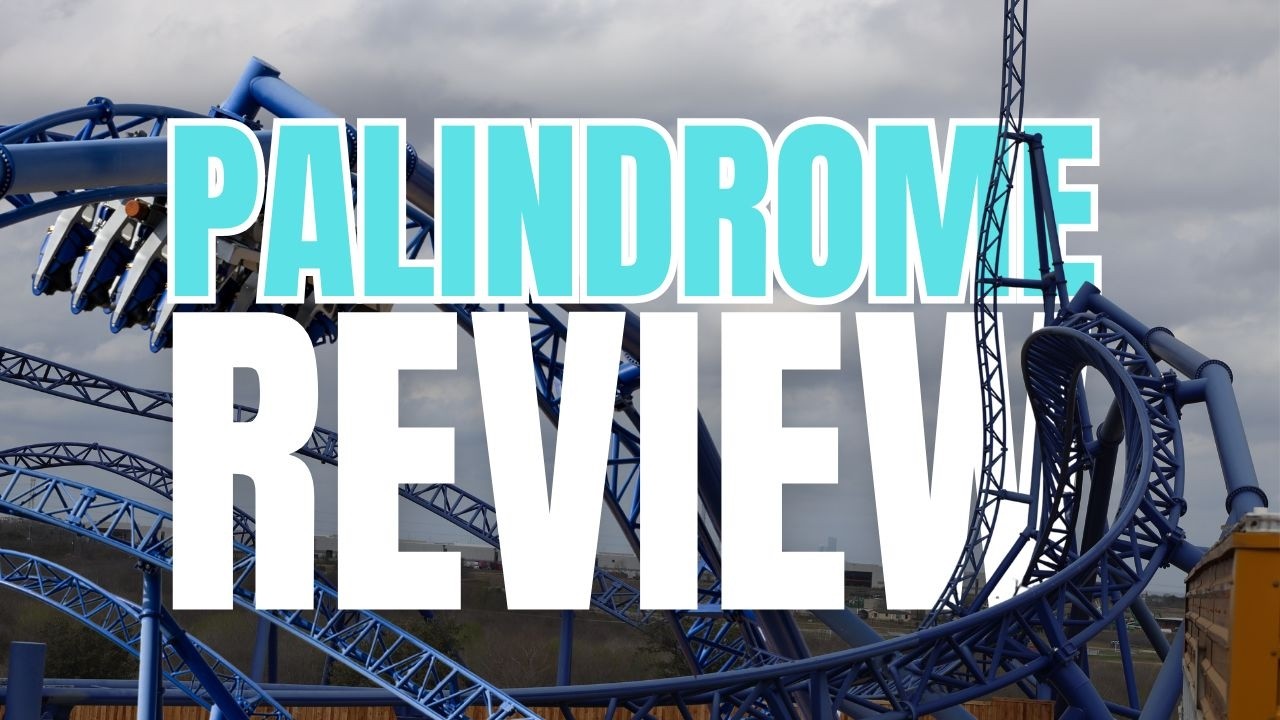
Palindrome fooled me.
I had watched this roller coaster being built and tested at COTALAND, and from the ground, it looked pretty mild. Everything seemed controlled. The layout looked compact, and I assumed it would be a good supporting ride next to Circuit Breaker.
Then I got the chance to ride it before COTALAND opened.
The park was still under construction, so most of my first ride looked like a roller coaster flying through a dirt field. Even without the finished landscaping and pathways around it, Palindrome immediately became one of my favorite roller coasters in Texas.
It hits much harder than it looks.
I underestimated Palindrome
Palindrome is a Gerstlauer shuttle coaster at COTALAND, the new amusement park being built at Circuit of the Americas in Austin.
Because it uses a shuttle layout, the train travels through the course once in the forward direction, climbs a spike, and then completes the elements again while running backward.
That already sounds fun, but videos do not communicate how forceful some of the transitions feel.
Watching Palindrome test, I saw a smooth vertical lift, a handful of compact elements, and a controlled trip through the layout. I expected it to be enjoyable. I did not expect the first half to feel so aggressive or the backward run to be so much fun.
The ride has two noticeably different personalities depending on which direction the train is traveling.
The open Gerstlauer trains fit the ride
Palindrome uses the simple, open trains I have come to expect from Gerstlauer.
The blue cars look good, and the lap bars leave plenty of space around your upper body. You do not feel boxed in by a bulky restraint, which allows the airtime and lateral forces to come through clearly.
That freedom becomes especially noticeable during the overbanked turns, the zero-G roll, and the spike.
The train is comfortable, but it does not separate you from what the Palindrome roller coaster is doing underneath you.
The vertical lift gives you a moment to look around
Palindrome begins with a short turn out of the station and heads directly toward its vertical lift hill.
I have always enjoyed Gerstlauer vertical lifts. There is something strange about lying back and looking straight into the sky while the train climbs beneath you.
Palindrome is not an especially tall roller coaster, so the trip to the top happens quickly. There is still enough time to look across COTALAND, Circuit of the Americas, and toward downtown Austin before the train reaches the first drop.
For a split second, everything feels calm.
Then Palindrome changes completely.
The first overbank hits immediately
The first drop sends the train into an overbanked turn above the road.
This was the first moment that caught me off guard. The transition throws you sideways and lifts you out of the seat so quickly that there is barely time to look at the street below.
The following S-bend arrives while you are still processing that first element. It adds another quick mix of airtime and lateral movement before the train sweeps toward the inversion.
This opening sequence is where Palindrome feels most intense. The slow climb creates a brief pause, and then the ride starts throwing forces at you almost immediately.
From outside the ride, those transitions look much more controlled than they feel from the train.
The zero-G roll feels different in each direction
After the S-bend, Palindrome makes a wide, swooping turn into its zero-G roll.
The inversion combines the floating feeling of hanging upside down with noticeable lateral movement. On the forward trip, everything happens quickly. The train carries enough speed that the roll feels like part of one continuous rush toward the end of the track.
The return trip is different.
Moving backward through the zero-G roll gives you more time to understand where you are. The element feels slower and more drawn out, allowing you to hang in the inversion instead of racing through it.
It is the same piece of track, but reversing the direction changes the experience considerably.
The spike was the biggest surprise
The vertical spike at the end of the forward run caught me completely off guard.
The front seat delivers a quick pop of airtime as the train begins climbing. As it continues upward and loses speed, that airtime turns into a moment of weightlessness before gravity pulls the train back through the course.
Front-row riders get the strongest version of that transition. Watching Taylor rise out of his seat in slow motion made it much easier to see how much movement the spike creates.
It looked mild during testing. Riding it told a different story.
Palindrome becomes a giggle machine on the way back
The backward half is where the ride becomes purely fun.
After dropping out of the spike, the train returns through the zero-G roll and sweeps backward into the S-bend. That section produces another sharp pop of airtime mixed with lateral force.
The train then moves into a slower stall above the road.
The forward overbank is fast enough that the view disappears almost immediately. Traveling backward through the same area gives you time to look down and enjoy how unusual the track placement is.
We kept calling Palindrome a giggle machine, and that description still fits it better than anything else I have found. The first half catches you with its intensity. The return trip gives you time to laugh at what just happened while delivering several more good moments of airtime.
The rotating switch track works quickly
After the backward run, the train hits the brakes while climbing the original drop.
It then rolls into position on Palindrome's rotating switch track. The platform turns the train and aligns it with the final section leading back to the station.
The entire process was quicker and smoother than I expected, especially while COTALAND was still under construction.
That switch track is an important part of the ride's operation. Palindrome needs to move trains through the rotation efficiently if it is going to handle regular crowds once the Austin theme park opens.
Seeing the system work so well during an early ride was encouraging.
Palindrome videos do not do it justice
I understand why Palindrome can be overlooked in videos.
It is compact, it does not rely on a massive first drop, and most of the elements look fairly controlled from the ground. Next to Circuit Breaker, it is easy to assume Palindrome will be the secondary roller coaster at COTALAND.
That assumption disappeared as soon as I rode it.
The transition from the vertical lift into the first overbank changes the pace instantly. The forward layout is forceful and chaotic, while the return trip is filled with the kind of moments that make everyone in the train start laughing.
Palindrome has airtime, lateral forces, two trips through a zero-G roll, a vertical spike, a stall above the road, and the unusual experience of completing half the layout backward.
Those ingredients come together better than I expected.
Palindrome gives COTALAND a strong second coaster
Circuit Breaker will receive plenty of attention as COTALAND's first tilt coaster, but Palindrome deserves to stand on its own.
It gives the Austin amusement park a roller coaster that feels approachable from the midway while still offering enough intensity for experienced riders. Its compact footprint also places a lot of movement close to the road, making it one of the most visible attractions at Circuit of the Americas.
Most importantly, it is fun in a way that is difficult to understand until you are sitting in the train.
I went into my first Palindrome ride expecting a mild supporting coaster. I came off thinking it was one of the best surprises in the Texas roller coaster lineup.
Once COTALAND opens and people finally get the chance to ride it, I think quite a few of them are going to have the same reaction.